



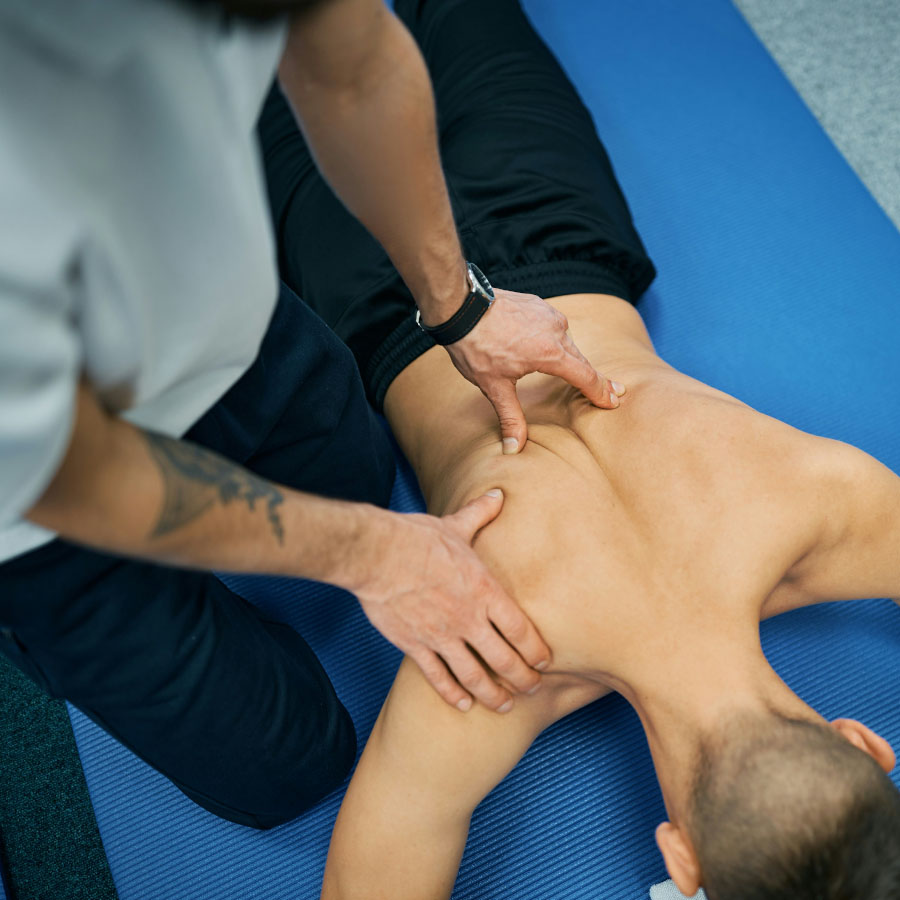


The rotator cuff is a group of muscles which help to control the movement of the shoulder’s ball and socket joint. If this control is inadequate then the muscles can become stressed, causing pain in the shoulder or upper arm, particularly when lifting the arm, lying on it or using the sore muscles.
Who gets rotator cuff related pain?
- People who work or do sports / hobbies with their hands above shoulder height.
- A shoulder injury or repetitive or unaccustomed activity may also cause the condition to develop.
- Rotator cuff problems can develop as we get older.
Why do we get rotator cuff related pain?
The rotator cuff is a group of muscles which help to control the movement of the ball and socket joint of the shoulder, with the tendon attaching the muscle to the humerus bone (upper arm bone). These tendons can either be intact or torn.
A number of other terms such as supraspinatus tendinopathy, tendinitis and bursitis are used by different people, but the diagnosis and treatment are essentially the same, and is referred to as rotator cuff tendinopathy. Overuse or unaccustomed activity, or sometimes trauma, such as a fall onto the hand or shoulder, can cause them to become painful
What happens to the tendons?
In the majority of cases, the tendon becomes painful without any serious damage and responds well to self-management, such as modifying your activity and progressive strengthening exercises. However, in some instances, the tissues can become inflamed (usually in younger people under the age of 40), show signs of degeneration or develop a tear.
A tear can be acute (sudden onset) following trauma, or can be chronic (long-lasting) due to tendon degeneration. Chronic tears are much more common in patients over the age of 60. A tear that does not extend the full way through a tendon is called a partial thickness tear.
Tears are very common, with up to 34% of the population having them. They do not always lead to pain and weakness and therefore do not always require surgery to repair them.
In smaller degenerative tendon tears, physiotherapy involving progressive strengthening exercise programmes has been shown to be very effective, as long as they are continued on a daily basis for at least 3 months and possibly up to 6 months.
What are the symptoms?
Shoulder and outer arm pain particularly when lifting the arm, lying on it or using the sore muscle, e.g. taking a jacket on or off
How can I deal with it?
- In the very early stages or with a flare up, have relative rest from the activity causing the pain.
- Gentle exercises to prevent your shoulder from stiffening up and to strengthen your muscles. It is fine to have some discomfort during your exercises as long as the discomfort is not severe, and settles within 30 minutes of your exercise.
- Pain relief as advised by your pharmacist or GP.
What should I do if this doesn’t help or if the symptoms are severe?
- Physiotherapists will plan an individual rehabilitation programme in order to improve your day-to-day function and increase or maintain your movement and strength.
- You may benefit from an injection if you fail to benefit from physiotherapy. However, this may not be done if you have a tear, and repeated injections are not recommended.
- You may require investigations, eg X-rays, ultrasound, etc, if your shoulder is not improving.
- You may require a surgical procedure if your symptoms are severe and fail to settle with self-management, pain management and adequate physiotherapy. However, in the vast majority of patients, management with physiotherapy is enough to settle symptoms.
How should I avoid?
- Avoid excessive unaccustomed activity with the hands above shoulder height eg painting a ceiling, hanging curtains and trimming the hedge in short periods of time.
- Take breaks from repetitive shoulder movements and heavy lifting.
- Try to keep your weight within normal limits, as individuals who are overweight have an increased risk of rotator cuff problems and tendon problems in general.
- If you exercise, ensure you balance your training programme to incorporate strength work for all muscle groups.
- Try to keep physically active.
Information & Guidance
Access our Health Hub



Physical Health
If you are struggling with a physical condition or injury that is affecting daily life, we offer a range of guidance to help reduce your symptoms, prevent further injury and improve your physical function to get you back to your best.




Related Articles

Pennine’s Fracture Liaison Service: Quietly transforming lives in Oldham
Discover how Pennine MSK’s Fracture Liaison Service in Oldham is leading the way in osteoporosis care, prevent

Tennis injuries: symptoms and prevention
Tennis injuries can be short or long term – these last ones being associated to the upper body (overuse).

5 Simple Tips for Back Care
Back pain is often, it’s your body reminding you to move, rest, or adjust your habits.

The benefits of physical activity for mental health
The benefits of finding even small moments for movement in our everyday lives are great.